On this page
- The Basics of Blade Steel
- The Danger of Scrap Steel
- What to Look for in a Beginner Steel
- Top Recommended Steels for New Bladesmiths
- Steels Beginners Should Avoid
- The Economics of Buying Known Steel
- Sourcing Your Materials
- Moving Forward
In Lesson 1, we covered the tools you need to get your shop running. Now it is time to talk about the other half of the equation: your steel.
Blade steel can feel overwhelming. There are hundreds (if not thousands) of options, and it is easy to get lost in technical arguments before you ever strike a hammer. The goal of this lesson is simple: I want to give you a small set of beginner-friendly steels that are forgiving to forge and easy to heat treat, so your early builds turn into real knives instead of expensive learning experiences.
These recommendations are based on how I run my shop. They are not the only way to do this, but choosing a good beginner steel can dramatically reduce guesswork, especially when you are heat treating in a regular forge instead of a lab-grade setup.
The Basics of Blade Steel
At its simplest, steel is iron with carbon added. That carbon is what lets the material harden when you heat it up and then quench it.
Metallurgists also add elements like vanadium, molybdenum, or tungsten to tune performance. Those additives can improve toughness, wear resistance, and corrosion resistance, but you do not need to master the entire chemistry to get started.
For now, focus on the two practical questions that matter at the anvil:
- Can you forge it without fighting it?
- Does it have a heat-treat window that you can successfully hit?
The Danger of Scrap Steel
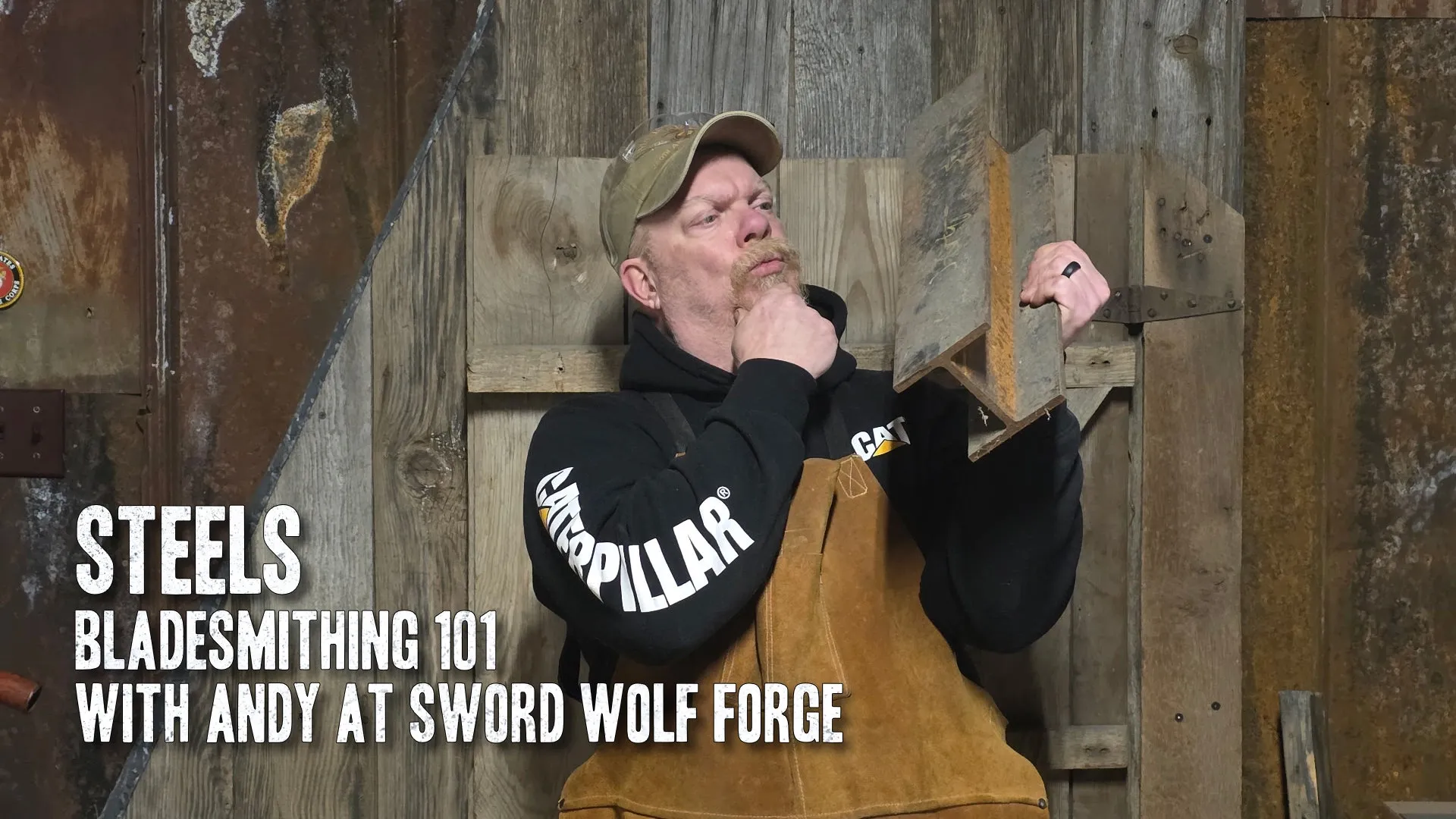
I love scrap for shop tools and fabrication projects. In my own shop, I have a pile of old railroad spikes too. I even make spike knives occasionally as novelty pieces. They are fun for practicing hammer blows and they make conversation pieces.
But for a serious, functional blade, railroad spikes are a hard pass. They simply do not have enough carbon to harden into a real edge-holding knife.
The same logic applies to most "mystery" scrap steel. You might find a leaf spring, a file, or a piece of machinery that looks like it might be high carbon. The problem is you cannot reliably know what it is until after you experiment (and experimenting costs time, steel, and results).
If you are going to pour hours of blood, sweat, and tears into forging and finishing a blade, do not gamble on unknown steel. Learn on steels with known recipes first, then branch out later when you understand what you are trying to accomplish.
What to Look for in a Beginner Steel
Before you buy, you want a steel that is beginner-friendly in four ways:
Forgeability: Does it move under the hammer without requiring a razor-thin temperature range?
Heat-treat forgiveness: Can you still get good results in a simple gas forge when your temperatures are not perfectly measured?
Availability: Can you reorder from multiple reputable suppliers if your first choice is out of stock?
Balanced performance: For your first knives, you want an all-around steel that is tough enough to take abuse and still holds a respectable edge.
Top Recommended Steels for New Bladesmiths
If you want the fastest path from "first knife" to "repeatable results," pick one of the steels below and make multiple blades with it. You will learn faster when you do not keep changing materials.
5160
My top recommendation is 5160. It is a classic spring steel historically used for heavy-duty leaf springs. It is tough, durable, and widely available. Most importantly, it forges well and has a forgiving heat treat, which makes it a great match for beginners heat treating by eye in a gas forge.
1084
If you want the beginner gold standard, 1084 is hard to beat. The 10 and 84 naming convention roughly reflects its carbon content (about 0.84% carbon). It is easy to forge and known for having a straightforward heat-treat process without overly fussy timing or special quench setups.
8670
8670 behaves similarly to 5160, and it is a solid option if you want another steel that is comfortable to work with early on. It moves nicely under the hammer and remains fairly straightforward through heat treat.
15N20
15N20 adds a bit more nickel than standard carbon steels, which can help with corrosion resistance. It is easy to find and relatively simple to heat treat.
It is also a future-friendly steel if you want to learn pattern-welded blades (Damascus). The higher nickel content etches to a bright silver color, giving you great contrast against darker steels like 1084.
ProCut
I have also been experimenting with a newer steel called ProCut (available through Pop's Knife Supply). It forges well and offers good corrosion resistance for a carbon steel.
That said, to fully unlock its performance potential, you may eventually want a more controlled heat treat (like a proper oven) rather than a simple forge. Treat it as a great step up as your skills grow.
Steels Beginners Should Avoid
There are a few paths that sound tempting, but they tend to slow down beginners.
No Such Thing as a "Super Steel"
A lot of marketing focuses on high Rockwell numbers, but there is no magical alloy that fixes bad heat treat or poor geometry. As a beginner, you usually will not be able to measure the difference between "59" and "61" Rockwell in a practical way.
Stick to a proven steel, focus on good grind geometry, and heat treat it correctly.
Avoid Stainless Steel (for now)
I do not recommend starting with stainless. Modern stainless can be excellent, but the heat-treat requirements are much stricter than simple high-carbon steels.
You typically need precise temperature control, exact hold times, and some advanced stainless may involve additional steps (including cryogenic phases) to reach their best performance. As a beginner, you will have enough learning curves without adding complexity.
Skip 1095 at First
1095 is a phenomenal steel, and it famously appears in blades like the Marine Corps Ka-Bar. The issue is that its heat treat can be more finicky and often needs a very fast temperature drop, which may mean engineered quenching oils.
When you are still learning hammer control, handle work, and edge geometry, do not pick a steel that fights you. Save 1095 for after you have a few successful builds under your belt.
The Economics of Buying Known Steel
Known steel costs money up front, but it saves you far more than it costs.
When you buy from a reputable supplier, you get a data sheet with the forging, normalizing, quenching, and tempering guidance for that specific alloy. That information is your recipe. It removes the guesswork and turns "experimentation" into "repeatable results."
When you grab random scrap, you are forced to create your own recipe. That usually means repeated trial, error, and wasted steel while you figure out the heat treat behavior.
Let me put it in simple shop math. I recently bought a bar of ProCut steel: 3/16-inch thick, 1.5 inches wide, and 48 inches long (about four feet). I paid $57.25.
That breaks down to roughly $1.19 per inch. If I cut a five-inch section to forge a standard hunting knife, I am investing about $5.95 in the steel for that blade. A five-inch blank can easily draw out into an eight- or nine-inch finished knife.
I will happily spend six bucks for the peace of mind of knowing what steel I am using and exactly how to heat treat it.
Do not risk your reputation or a customer's safety by using mystery scrap. Spend a few dollars on reliable materials. It pays off massively in the long run.
Sourcing Your Materials
Now you know what to look for, but where do you buy it?
Before the list, quick note: I am not affiliated with any of these suppliers, and I am not being paid to promote them. These are just reputable companies I have used over the years.
Also, avoid buying blade steel on Amazon when you can. It is too hard to verify where the steel came from and whether it is labeled correctly. Stick to dedicated knife-making suppliers.
Common places to check:
- Pop's Knife Supply
- Jantz Supply
- New Jersey Steel Baron
- KnifeKits.com
- Maritime Knife Supply
- USA Knifemaker
Any of those vendors can set you up with bars of 5160 or 1084 so you can start forging with confidence.
Moving Forward
That wraps up our discussion on the best steels for new bladesmiths. We covered a lot of ground, but the goal was to strip away the confusing jargon so you can focus on what actually matters at the anvil.
In our next Bladesmithing 101 video, we are going to talk about planning. We do not want to fire up the forge and start hammering with zero direction. We will cover the critical steps to think through before that steel ever gets hot.
To keep up with the whole series and see these steels in action, be sure to head over and subscribe to our YouTube channel: https://www.youtube.com/@SwordWolfForge
If you have questions about which steel to buy or how to heat treat it in your setup, reach out through the contact form and I will point you in the right direction. And if you missed it, start with Lesson 1: The Essential Tools You Need to Start Bladesmithing. When you are ready for the next step, continue with Lesson 3: Planning Can Save Your Steel.